
Faulty Wiring in Brain May Cause Stuttering
Laino, Charlene – from Neurology Today: June 2003 – Volume 3 – Issue 6 – p 24–27
Over the years, short, wet tongues, sibling rivalry – even too much sex – have been blamed for stuttering.
Now, New Orleans researchers have evidence pointing to what some say is a much more likely cause of the debilitating stammer that afflicts some 60 million people worldwide: faulty wiring in the brain.
“What we found was dramatic,” said Anne L. Foundas, MD, Associate Professor of Neurology at Tulane University Health Sciences Center in New Orleans, LA. “Adults with atypical anatomy of auditory temporal brain regions appear to have atypical auditory processing and are also more severe stutterers.”
Importantly, she said, the findings open up the door for the development of new targeted therapies to treat stuttering. The study was funded by the National Institutes of Health, the Charles A. Dana Foundation, and the Department of Veterans Affairs.
SIZE OF PLANUM TEMPORALE
It all started with a 2001 study in which Dr. Foundas and colleagues found that a portion of the auditory association cortex known as the planum temporale, which is normally larger in the left hemisphere, was larger and more symmetric in both hemispheres in people who stutter.
Given that the left hemisphere is typically dominant for language functions, “that finding made us ask ourselves if there is a link between atypical anatomy and dysfunction,” she said.
“In people who don’t stutter, there may be atypical activation of the auditory temporal cortex, which may induce atypical activation of interconnected neural networks that mediate speech-language production,” she explained.
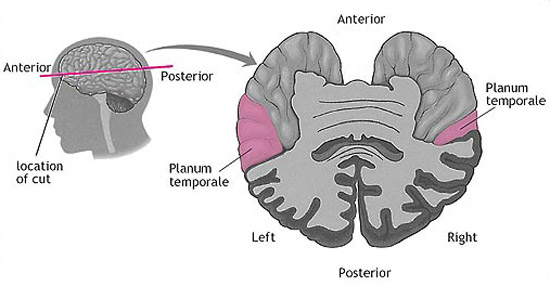
Image courtesy of Open University
STUDY DESIGN
To test this hypothesis, her team used delayed auditory feedback, in which a person speaks into a microphone and then, after a short pause, hears their speech played back via headphone. Delayed auditory feedback induced fluency in many people who stutter, suggesting that there may be a defect at the level of auditory processing that is at least partially reversed by the technique, Dr. Foundas said.
The study enrolled 14 adults with persistent developmental stuttering and 14 fluent controls matched for age, sex, education, and handedness. Their average age was 31, and most were right-handed men – as are most adults who stutter.
The volunteers read prose passages, each of which was about 250 syllables, under three conditions: at baseline, with no equipment and no delay in auditory feedback; with non-altered feedback, with headphone earplugs inserted but no delay in auditory feedback; and with delayed auditory feedback, in which earplugs are inserted and auditory feedback is delayed 120 milliseconds.
MEASURES OF FLUENCY
The researchers then evaluated three measures of fluency: stuttering event frequency, a ratio of the number of stuttering events to the number of syllables read; stuttering severity, as measured on a standardized stuttering scale; and reading time, the number of seconds it took to read the passage.
As expected, the adults with persistent developmental stuttering were significantly more dysfluent for all three measures at baseline, compared with controls, the study showed.
Many of the stutterers spoke more fluently when aided by delayed auditory feedback, while non-stutterers became slightly less fluent.
When the researchers considered the results in relation to anatomy, delayed auditory feedback had induced fluency only in those stutterers with atypical rightward planum temporale asymmetry, Dr. Foundas said. Stutterers with normal anatomy did not significantly improve.
Dr. Foundas said that the findings suggest that adults with persistent stuttering and atypical anatomy have a defective speech monitoring system that may make them susceptible to worse stuttering.
“If we can slow the feedback to this defective circuitry, maybe we could correct the stutter,” she said.
OUTSIDE COMMENTARY
Andrew Stuart, PhD, who has done extensive work on delayed auditory feedback and stuttering for over a decade, said the work was interesting and well done.
Dr. Stuart, Associate Professor in the Department of Communication Sciences and Disorders at East Carolina University in Greenville, NC, said; “I accept their finding that the anatomy of the plenum temporale is aberrant in some people who stutter. While some researchers are more impressed with studies that have large numbers [in their cohort], they should be more impressed with a significant finding in a small number of people. That means the effect is so strong you only need a small number to prove it.”
OTHER STUDIES
Dr. Stuart noted that the research findings are supported by other studies that have implicated unusual brain pathology in stuttering. He cited PET scan research by investigators at the University of California-Santa Barbara, involving the brains of people who stutter and those who don’t (Brain 2000;123(10):1985–2004). In those who don’t stutter, the researchers found that both hemispheres light up during speech, with hot spots on the left. But in those who do stutter, there was more activity on the right.
The study also found that a region of the brain involved in hearing is quiescent in stutterers when they talk, suggesting that many try to tune out their stammering speech.
LEFT HEMISPHERE OF BRAIN
Hamburg University scientists also implicated the left hemisphere of the brain in stuttering. Their study, published in The Lancet (2002;360: 380), described evidence for a structural abnormality in speech-related areas in the left rolandic operculum of people with persistent stutters.
Nevertheless, Dr. Stuart said, “I have to ask if any of these findings get us any closer to knowing the cause of stuttering.” The problem, he said, is that aberrant brain structure and processing could be a consequence – not a cause – of the stammer. “The brain is very plastic,” he said.
Dr. Foundas said there is some evidence implicating faulty wiring and processing as the culprit, rather than as a byproduct of stuttering. “If you look at the plenum temporale, the asymmetry is present in the neonatal brain as early as 28 weeks of gestational age and the degree of asymmetry does not change into childhood and adolescence,” she said. “Therefore we think that it’s hardwired – almost part of the genotype.”
EVIDENCE IS PRELIMINARY
That said, “the evidence is preliminary and even when things are hardwired, there is some plasticity and can be remodeling,” she said. “Dr. Stuart’s point is well taken and worthy of further study.”
The next step, Dr. Foundas said, is to try to identify some of the other areas of the brain involved in stuttering. “Since adults with persistent developmental stuttering who had typical planum temporale asymmetry did not become more fluent with delayed auditory feedback, other neural systems are likely to be involved,” Dr. Foundas said.
Studies of children may also help shed light on the question, she added. About 4 percent of children stutter and in about 20 percent, the stutter persists into adulthood. “That is the group we studied,” Dr. Foundas said. “Now we want to find out if the anatomy is different in the 80 percent of kids who do recover.”
©2003 American Academy of Neurology